

The Anne Frank Zentrum is the German partner organization of the Anne Frank House in Amsterdam. The permanent exhibition “All about Anne” on view at the headquarters near Hackescher Markt in the heart of Berlin turns the spotlight on Anne Frank and her diary. Numerous historic photographs and documents illustrate the stations of her life. The presentation is a learning environment that lets visitors explore Anne Frank’s life and diary and helps them develop a personal interest in the history of the Holocaust. Interactive installations encourage them to engage with the material and find their own answers to the question of what Anne Frank’s story has to do with their own lives today and what it means to them.
Our Educators offer guided tours of the exhibition for school and other groups that are custom-tailored to their age and level of previous knowledge. We also regularly hold events such as readings, conversations with Holocaust witnesses, film screenings, seminars, and panel discussions. Most of the exhibition “All about Anne” is inclusive, with monitors displaying translations into sign language and an orientation system for blind visitors. A comprehensive glossary and labels and wall texts in plain language ensure that the presentation is accessible to all visitors, including those with learning disabilities. Among the tactile exhibits are a model of the Secret Annex, a portrait of Anne Frank, and a Braille edition of her diary.
The Anne Frank Zentrum is part of a diverse ensemble of institutions that share a historic edifice, the Haus Schwarzenberg. In addition to the Anne Frank Zentrum, the building at Rosenthaler Straße 39 is also home to the Museum Otto Weidt’s Workshop for the Blind.
Address
Anne Frank Zentrum
Rosenthalerstrasse 39
10178 Berlin
Tel.: +49 (0)30-28 88 656-00
Fax: +49 (0)30-28 88 656-01
E-Mail: zentrum@annefrank.de
Internet: http://www.annefrank.de/en
The institution on google maps
S-Bahn/Tram Hackescher Markt
U-Bahn Weinmeisterstraße
Opening Hours:
Tue-Sun 10am-6pm
The exhibition is wheelchair accessible.
Admission:
Adults: 7 euros, Concessions: 4 euros
Families: 15 euros
Children up to the age of ten: free entry
The exhibition is wheelchair accessible.
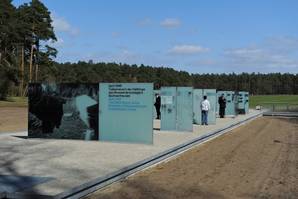 On April 21, 1945 with the approach of the Red Army, the SS forced 30,000 prisoners from the Sachsenhausen Concentration Camp, among them women and children, to walk northwest on a death march. For most of them, the march ended with their liberation between the 3rd and 6th of May 1945 around the Parchim, Ludwigslust, Schwerin area. However, hundreds died on the way or were shot by the SS.
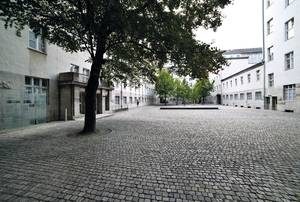 The German Resistance Memorial Center is located at 13–14 Stauffenbergstraße, on the historical site of the attempted coup of July 20, 1944, at the former Army High Command. Since 1953, the commemorative courtyard had been a site of remem-brance for resistance to National Socialism.
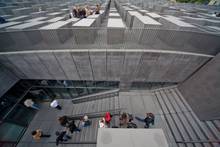 After many years of debate, the German Parliament finally decided to build the “Memorial to the Murdered Jews of Europe” on June 25, 1999. The memorial was built from April 2003 to May 2005 following New York architect Peter Eisenman’s designs, modified by the addition of an underground Information Centre (Ort der Information). It is located right in the middle of Berlin, in close proximity to the Brandenburger Tor and the Reichstag building.
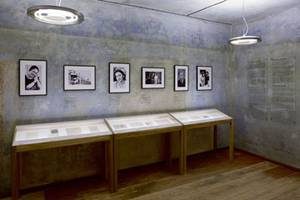 The Museum Otto Weidt’s Workshop for the Blind tells the story of Otto Weidt’s Workshop for the Blind. During the Second World War the brush manufacturer Otto Weidt employed mainly blind and deaf Jews who produced brooms and brushes here. Various life stories testify to Otto Weidt’s efforts to protect his Jewish employees from persecution and deportation. As danger grew, he searched for hiding-places for some of them. One of these hideouts was in the rooms that are now part of the museum.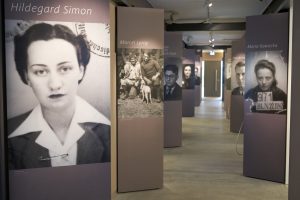
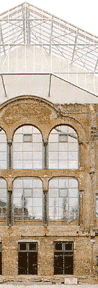 The New Synagogue had its formal opening as a part of the Jewish New Year’s celebration in 1866. The New Synagogue was the largest Jewish place of worship in Germany, with 3,200 seats. The famous Berlin architect Eduard Knoblauch’s (1801-1865) design was inspired by the Moorish style of the Alhambra in Granada. The gilded ribbing design of the over 50 meter high dome was famous in and outside of Germany. The building was desecrated in the 1938 November Pogrom, however it was protected from any extensive damages. It was badly damaged due to bombings during World War II and the synagogue’s main room was blown up in 1958.
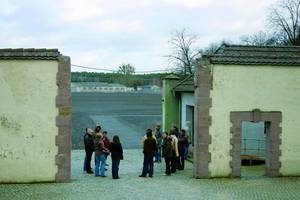 The Ravensbrück Concentration Camp, built in 1939 close to the small town of Fürstenberg/Havel, was the largest concentration camp for women on German soil. Between 1939 and 1945, 132,000 women, 20,000 men and 1,000 young women from the ”Youth Protection Camp Uckermark” were registered as prisoners. The prisoners came from over 40 countries; there were many Jews as well as Sinti and Roma among them. Tens of thousands were murdered or died from hunger, illness or medical experimentation. After the Red Army liberated the camp on April 30th, 1945, the land was used by them for military purposes until 1994. The Ravensbrück Memorial Site, opened in 1959, has been a part of the Brandenburg Memorial Foundation since 1993.